If you live with Postural Orthostatic Tachycardia Syndrome (POTS), you already know how complicated it is to explain.
Your symptoms change day to day.
Your test results don’t always reflect how bad you feel.
Some treatments help something, but rarely everything.
Most people with POTS aren’t chasing a miracle cure. They’re trying to function better, crash less often, and be seen as more than a heart rate graph or a tilt-table result.
That’s often where curiosity about homeopathy begins.
POTS Isn’t “Just One Problem”
Conventional (allopathic) medicine approaches POTS through measurable mechanisms:
Heart rate
Blood pressure
Blood volume
Autonomic nervous system regulation
This approach is essential. It keeps people safe. It provides diagnosis, monitoring, and symptom control.
But people living with POTS usually notice something else that doesn’t fit neatly into protocols:
Symptoms worsen with stress, poor sleep, illness, or emotional overload
Fatigue, brain fog, anxiety, GI symptoms, pain, and temperature intolerance overlap
The condition affects the entire nervous system—and daily life as a whole
POTS isn’t just cardiovascular. It’s systemic. It’s relational. It’s exhausting.
Homeopathy starts from that lived reality.
Treating the Pattern, Not Just the Pulse
Homeopathy doesn’t treat “POTS” as a label. It looks at patterns.
It pays attention to:
How your dizziness actually feels
What reliably triggers crashes or flares
How your body responds to standing, heat, exertion, stress, or sensory input
Your sleep quality, emotional state, energy rhythms, and recovery time
Two people can meet the diagnostic criteria for POTS and experience it completely differently. Homeopathy is built around that individuality.
That’s why some people with POTS explore it alongside standard medical care—not instead of it.
Symptoms as Signals, Not Failures
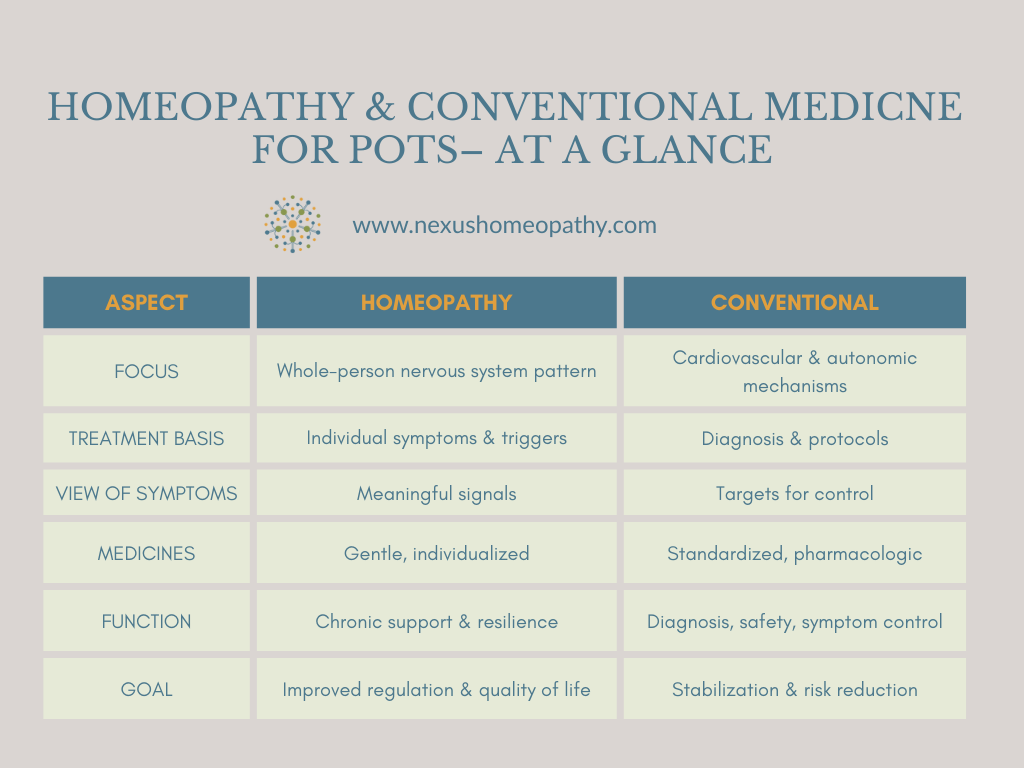
In conventional medicine, symptoms are often something to suppress or control.
In homeopathy, symptoms are viewed as information—signals of nervous system dysregulation and reduced adaptive capacity.
The goal isn’t to overpower the system or force it into compliance.
It’s to support regulation, resilience, and recovery over time.
That long-view matters in chronic, relapsing conditions like POTS.
Gentle, Long-Term Support
Homeopathic remedies are chosen based on similarity to an individual’s symptom pattern and are non-toxic and gentle.
This is important for many people with POTS who are:
Medication-sensitive
Managing multiple prescriptions
Dealing with side effects or limited tolerance
Equally important: homeopathic consultations are often 90-120 minutes.
Your story isn’t rushed. Your experience isn’t reduced to vitals taken while standing.
For many patients, that alone feels different.
Not a Replacement — A Different Kind of Support
Allopathic care remains essential for POTS:
Diagnosis
Monitoring
Medications
Safety
Homeopathy offers something else:
A whole-person lens
Individualized care for complex symptom patterns
Support aimed at long-term regulation rather than constant crisis management
For some people with POTS, using both feels more complete than relying on either alone.
Living with POTS often means becoming your own advocate. Exploring homeopathy doesn’t mean rejecting conventional medicine—it means asking for care that matches the complexity of your condition and your lived experience.
Final Thought
Living with POTS means living inside a nervous system that reaches its limits quickly—and recovers slowly. Care that is thoughtful, individualized, and respectful of those limits can make a real difference.
For many people, finding the right practitioner—not the perfect treatment—is the most important first step.
If you are experiencing POTS, MCAS, hEDS or any chronic illness, and would like to learn more about homeopathy and how it can potentially help you, please contact me.
Josie Semmes, LPH,CHP, CCH, CH, has been in practice for over 4 years and received her homeopathy degree from the Canadian College of Homeopathic Medicine. She specializes in helping those with chronic conditions, with a focus on helping patients with POTS/EDS/MCAS and those with other types of Dysautonomia. She also holds certifications as a clinical herbalist and nutritionist. She is a board-certified Homeopath and licensed practitioner through the State of Arizona.
Disclaimer: This article is for educational purposes only. It should not replace the advice of your primary care physician (PCP) or other physicians which you are providing you care. It is recommended that you consult with your PCP before starting homeopathic medicine or any other form of complementary medicine. Do not use this article as a means to diagnose a health condition. Speak to your PCP if you think that your condition may be serious, or before discontinuing any medication that has been prescribed for you, or before starting any new treatment.